
The Complete Physician Guide to PRP Hair Therapy
Hair thinning is one of the most emotionally impactful aesthetic concerns patients experience.In Los Angeles, regenerative medicine approaches to hair loss are rapidly increasing in popularity because patients want to address the biological causes of hair thinning, not simply mask it cosmetically.One of the most common questions is: Does PRP hair restoration actually work?
The answer depends on:
- The stage of hair loss
- The underlying cause
- Treatment protocol
- Provider expertise
At Ortali Wellness, PRP hair restoration is approached as follicular regenerative medicine, not cosmetic thickening. The goal is to preserve and stimulate living hair follicles for long-term density and scalp health.
What Is PRP Hair Restoration?
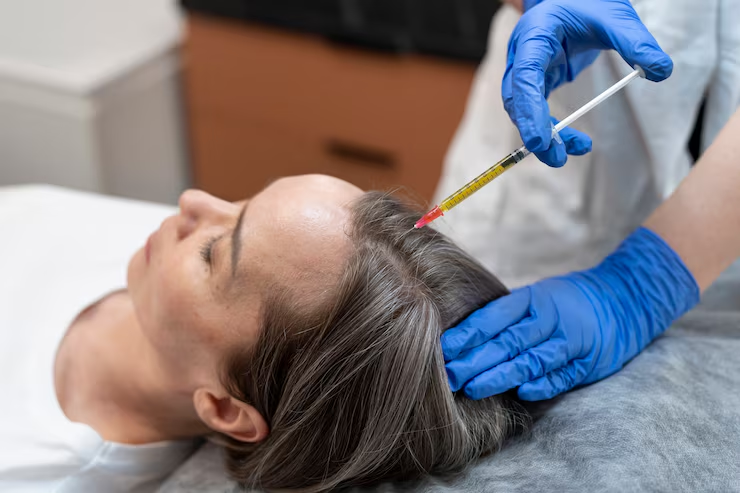
Platelet-rich plasma (PRP) therapy uses the patient’s own blood-derived growth factors to stimulate hair follicle activity.The procedure involves:
- Drawing a small blood sample
- Processing it in a centrifuge
- Isolating concentrated platelet-rich plasma
- Injecting PRP into areas of hair thinning
PRP contains biologically active growth factors including:
- Platelet-derived growth factor (PDGF)
- Vascular endothelial growth factor (VEGF)
- Insulin-like growth factor (IGF-1)
These signaling proteins may help stimulate follicle repair, improve vascular supply, and support hair cycle normalization.
Understanding Hair Loss at the Biological Level
To determine whether PRP works, it’s important to understand hair biology.Hair follicles cycle through three primary phases:
Anagen Phase (Growth Phase)
Active hair production occurs.
Catagen Phase (Transition Phase)
Hair growth slows.
Telogen Phase (Resting and Shedding Phase)
Hair sheds naturally.In conditions such as androgenetic alopecia (male or female pattern hair loss):
- The anagen phase shortens
- Follicles gradually miniaturize
- Hair strands become thinner
- Follicles may eventually become dormant
PRP therapy aims to prolong the growth phase, improve follicle health, enhance scalp circulation, and reduce inflammatory signaling.It works best when follicles are still alive but weakened.
What Types of Hair Loss Respond Best to PRP?
PRP hair restoration in Los Angeles is most effective for early to moderate hair thinning.Ideal candidates include patients with:
- Male pattern hair thinning
- Female pattern hair thinning
- Postpartum hair shedding
- Stress-related hair loss
- Early androgenetic alopecia
PRP is generally less effective for:
- Advanced baldness
- Completely dormant follicles
- Long-standing severe follicular miniaturization
Early intervention significantly improves outcomes.
PRP for Female Hair Loss
Female hair thinning often presents as diffuse volume reduction rather than localized bald spots.PRP may help improve:
- Hair density
- Strand thickness
- Follicle strength
- Scalp vascularity
Because female hair loss can be influenced by hormonal shifts, thyroid dysfunction, iron deficiency, or metabolic changes, comprehensive medical evaluation is often recommended.In regenerative medicine, scalp treatment alone is rarely the full solution.
PRP for Male Pattern Hair Loss
PRP may help slow progression of male pattern baldness, particularly in early stages.It is often combined with:
- Topical medications
- Hormonal modulation (when medically appropriate)
- Nutritional optimization
- Microneedling scalp stimulation
PRP is not typically a replacement for surgical hair transplantation in advanced stages — but it can be used to enhance transplant survival and improve overall scalp health.
PRP vs Hair Transplant Surgery
Hair transplant surgery relocates existing healthy follicles. PRP works by strengthening and stimulating existing follicles.They serve different purposes:
- Transplants restore areas with significant follicle loss
- PRP preserves and revitalizes thinning areas
In advanced regenerative hair restoration strategies, combining both approaches often yields optimal results.
How Many PRP Treatments Are Needed?
Typical PRP hair restoration protocols include:
- 3–4 initial sessions
- Spaced approximately 4 weeks apart
Maintenance treatments every 6–12 months depending on progression.Hair growth is a slow biological process. Patients should not expect instant cosmetic thickening. Consistency and patience are essential.
When Will You See Results?
Hair restoration follows the natural hair cycle timeline.
Month 1–2
Reduced shedding may occur.
Month 3–6
Visible improvement in density and strand thickness may begin.
Month 6–12
Continued follicular strengthening and stabilization.Results vary based on age, genetics, hormonal factors, and systemic health.
Is PRP Hair Treatment Painful?
Discomfort is generally mild. At Ortali Wellness:
- Topical numbing is applied
- Injection techniques are optimized for comfort
- Treatment depth is customized
Most patients tolerate PRP well with minimal downtime.
Is PRP Hair Restoration Safe?
PRP has a strong safety profile because it uses the patient’s own blood components. Temporary side effects may include:
- Mild scalp tenderness
- Slight swelling
- Pinpoint bleeding
- Temporary redness
Serious complications are rare when sterile protocols and proper technique are followed.
Why PRP Works Better in Early Hair Loss
Regenerative medicine is most effective when follicles are still viable. Once follicles become completely inactive or fibrotic, stimulation becomes significantly less effective. This is why patients often see better results when treatment begins early — before visible scalp exposure progresses. Preventative hair restoration is increasingly common in Los Angeles longevity-focused practices.
Combining PRP With Other Regenerative Therapies
Hair health is influenced by systemic biology, not just scalp treatment. Optimal results often involve:
- Nutritional optimization
- Iron and vitamin evaluation
- Hormone balance assessment
- Stress management
- Scalp microneedling
- Regenerative peptide therapies (when appropriate)
Comprehensive evaluation improves long-term outcomes.
Who Is an Ideal Candidate for PRP Hair Restoration?
PRP may be appropriate for patients who:
- Notice early thinning
- Experience increased shedding
- Want non-surgical options
- Prefer natural regenerative approaches
- Are not ready for hair transplant surgery
It may be less effective for advanced baldness with complete follicle loss. Medical evaluation is always recommended before starting treatment.
How Much Does PRP Hair Restoration Cost in Los Angeles?
Typical pricing ranges $500–$1,500 per session. Cost depends on:
- Provider expertise
- PRP preparation quality
- Treatment protocol
- Clinic setting
The quality of centrifugation, platelet concentration, and injection technique significantly affects outcomes. Extremely low pricing may indicate suboptimal preparation methods.
Final Thoughts: Does PRP Hair Restoration Work?
PRP hair restoration is one of the most promising regenerative treatments in modern aesthetic medicine. While it is not a universal cure for all types of hair loss, it can be highly effective for:
- Early intervention
- Follicular preservation
- Slowing progression
- Supporting long-term density
For patients in Los Angeles seeking non-surgical, biologically driven hair restoration, PRP offers a safe and regenerative option when performed by experienced medical professionals. At Ortali Wellness, PRP hair restoration is incorporated into a comprehensive, physician-led regenerative medicine strategy designed to optimize scalp health and preserve hair longevity.